Money
Unit Price Comparison
Compare package prices by ounce, fluid ounce, metric quantity, or individual item.
Normalize different package sizes and units so you can compare the actual cost of what you are buying.
Open calculatorMeasurement and practical explanations
Convert, compare, and understand the measurements that show up in projects, shopping, recipes, repairs, and everyday planning. The goal is not just a converted number—it is knowing what that number means.
Use this hub when units, dimensions, fractions, or quantities are getting in the way of a decision. Start with a tool for the arithmetic, then use the explanations to check whether you are measuring the right thing in the right unit.
Start here
Money
Compare package prices by ounce, fluid ounce, metric quantity, or individual item.
Normalize different package sizes and units so you can compare the actual cost of what you are buying.
Open calculatorMoney
Solve common percentage questions, percentage change, and increases or decreases with the formulas shown.
Handle everyday comparisons such as discounts, markups, growth, reductions, and the percentage represented by one value of another.
Open calculatorHome
Estimate paint for a room or wall with coats, openings, coverage, and waste included.
Account for doors, windows, multiple coats, and a practical waste allowance before buying paint.
Open calculatorHome
Estimate volume, concrete bags, or gravel weight for rectangular and circular projects.
Switch between U.S. and metric measurements, include waste, and use editable bag yield or gravel density assumptions.
Open calculatorHome
Scale ingredient quantities up or down for a different number of servings while preserving the original ratio.
Enter the original serving count and the desired count to resize every ingredient consistently.
Open calculatorMeasurement
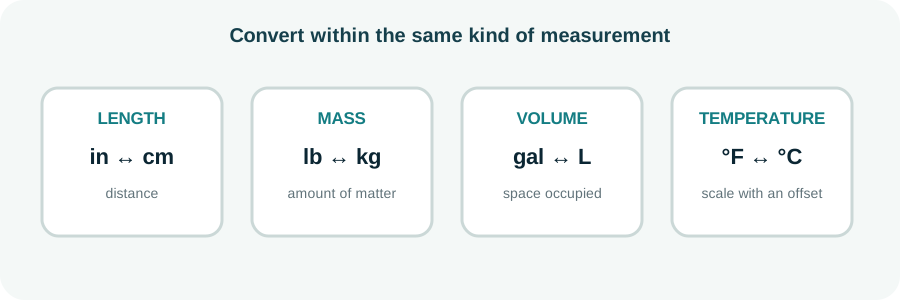
Convert common length, mass, volume, and temperature measurements between U.S. customary and metric units.
Choose a measurement type and units to see the conversion, the formula used, and a reminder about what the units describe.
Open calculatorUnderstand the decisions
Understand the difference between familiar U.S. customary measurements and metric units before converting.
Make common tape-measure, package, area, and volume numbers easier to read and compare.
Learn the terms that matter when identifying a screw, bolt, nut, or threaded connection.
Review fractions, decimals, dimensions, area, volume, thread count, pitch, and fastener sizing.
Keep common conversions, fractions, temperature formulas, and fastener terms on one page.
Practical starting points
Normalize package sizes so you can compare the cost of the same unit.
Open the calculatorConvert common length, mass, volume, and temperature measurements between systems.
Open the calculatorLearn how familiar fractions relate to decimals and why the unit still matters.
Read the explanationReview when to use square units for surfaces and cubic units for three-dimensional space.
Read the explanationUse the guide to understand diameter, thread pitch or count, length, and system.
Read the explanationStart with the unit
“SAE” is commonly used to describe U.S. customary sizes such as inches, feet, ounces, and pounds. Metric measurements use millimeters, centimeters, meters, grams, kilograms, milliliters, and liters. The systems are not interchangeable by simply changing the label, so always record the unit beside the number.
Inches and feet are common in U.S. projects. Millimeters, centimeters, and meters are common in metric plans and product specifications.
Ounces and pounds are common package labels in the U.S. Grams and kilograms are common metric labels. Weight and volume describe different properties.
Cups, quarts, gallons, milliliters, and liters describe volume. Do not convert a weight to a volume without knowing the material’s density.
Read the measurement
A fraction such as 3/8 means three of eight equal parts. Divide the top number by the bottom number to get the decimal: 3 ÷ 8 = 0.375. Keep the original unit attached to both forms.
Area measures a surface, so it uses square units. Volume measures space, so it uses cubic units. A 10-by-10-foot surface is 100 square feet; adding a 4-inch depth creates a volume calculation that must use compatible units.
Hardware language
A fastener’s diameter, length, thread pattern, head style, material, and strength can all matter. Thread pitch describes the distance between threads in a metric specification; threads per inch describes how many threads fit into one inch in a U.S. specification. A fastener that looks close may still be the wrong size or thread.
Practical boundary: bring the original fastener, a measurement, or the manufacturer’s specification when matching hardware. Do not force a nut or bolt that does not thread smoothly, and do not treat a visual match as proof of compatibility for structural, automotive, pressure, or safety-critical work.
Help us keep it useful
Send a correction or tell us what would make this page more helpful. Please include the page address and the specific detail you are referring to.